
What Is Edge Computing? How It Works, Benefits, Examples, and Future
The way computers process information is changing. For many years, applications relied heavily on centralized cloud data centers to store information and perform computing tasks. That model remains extremely important, but it isn’t always ideal when an application needs a response in milliseconds or when enormous amounts of data are generated by connected devices.
This is where edge computing comes in.
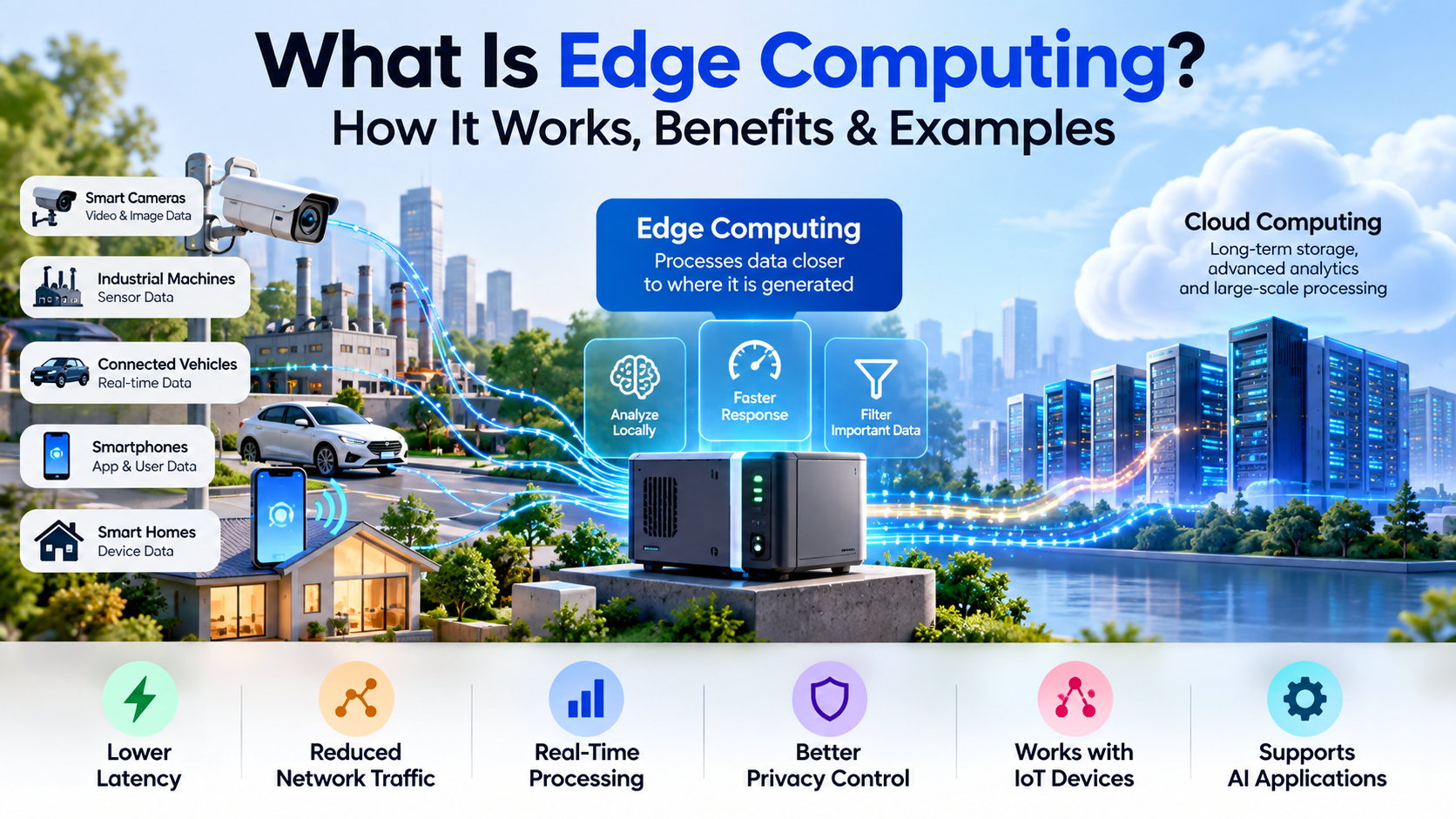
Edge computing moves some computing and data-processing tasks closer to the location where the data is generated. Instead of sending every piece of information to a distant cloud data center, an edge device, gateway, or nearby server can process some of that information locally. NIST research describes edge computing in terms of bringing computing closer to devices, sensors, and data sources, while IBM describes it as a distributed framework that places applications closer to their data sources. (NIST)
This approach can be particularly useful for connected devices, smart factories, autonomous systems, video analytics, healthcare technology, smart cities, and applications that require fast responses.
But what exactly does edge computing mean, and why is it becoming an important part of modern technology?
Let’s break it down.
What Is Edge Computing?
Edge computing is a computing approach that processes data closer to where that data is created instead of relying entirely on a centralized cloud or data center.
The “edge” refers to the part of a network that is close to users, devices, sensors, machines, and other sources of data.
For example, imagine a security camera installed in a factory.
A traditional approach might send all of the camera’s video to a remote data center for analysis.
With edge computing, a nearby computer or edge device could analyze the video locally and send only important information to the cloud.
For example:
Camera
   ↓
Edge Device
   ↓
Local Analysis
   ↓
Important Information
   ↓
Cloud
This can reduce the amount of information traveling across the network and allow certain decisions to happen closer to the source.
Why Was Edge Computing Developed?
Modern devices generate enormous amounts of data.
Smartphones, cameras, vehicles, industrial machines, medical devices, sensors, and smart-home products can continuously collect information.
Sending every piece of that data to a centralized data center can create several challenges.
Network latency
Latency is the delay involved in sending and processing information.
When an application needs an immediate response, sending data to a distant server and waiting for a response may introduce unnecessary delay.
Processing information closer to the source can reduce that communication distance.
Network bandwidth
Large amounts of raw data require network capacity.
Video cameras are a good example. A system with hundreds of cameras could generate a huge amount of video data.
Instead of sending everything to the cloud, edge computing can process or filter information locally before sending selected data elsewhere.
Real-time applications
Some systems need to respond quickly.
Examples include:
- Industrial monitoring
- Autonomous systems
- Smart traffic systems
- Security cameras
- Robotics
- Certain healthcare applications
- Real-time analytics
NIST research identifies proximity to data sources as an important characteristic of edge architectures and notes potential benefits such as reduced latency and network requirements. (NIST)
How Does Edge Computing Work?
Edge computing isn’t a single device or piece of hardware. It is an architecture that can involve devices, local computing systems, networks, and cloud services.
A simplified edge computing system can look like this:
Data Source
     ↓
Sensor / Device
     ↓
Edge Device or Gateway
     ↓
Local Processing
     ↓
Useful Results
     ↓
Cloud / Data Center
     ↓
Long-Term Storage & Advanced Analysis
Let’s look at each stage.
1. Data Is Generated
The process begins with a device or sensor collecting information.
Examples include:
- Temperature sensors
- Cameras
- Smartphones
- Vehicles
- Industrial machines
- Wearable devices
- Smart appliances
2. Data Reaches an Edge Device
The information can then be sent to a nearby computing device.
This might be:
- An industrial computer
- A local server
- An IoT gateway
- A network device
- A smartphone
- Another capable connected device
3. Local Processing Takes Place
The edge system analyzes the information.
Instead of automatically sending every piece of raw data to the cloud, the system can determine which information needs further processing or storage.
4. Important Information Goes to the Cloud
The cloud still has an important role.
The edge doesn’t necessarily replace cloud computing.
Instead, the two can work together.
For example, an edge device might process sensor information locally while the cloud stores historical information and performs larger-scale analysis.
Edge Computing vs Cloud Computing
Edge computing and cloud computing are sometimes presented as competitors, but they don’t necessarily have to be.
They can complement each other.
| Feature | Edge Computing | Cloud Computing |
|---|---|---|
| Processing location | Near the data source | Centralized data centers |
| Response time | Can be very fast for local tasks | Depends partly on network connection |
| Network traffic | Can reduce transmitted data | Can require more data transfer |
| Large-scale computing | Usually limited by local resources | Very strong |
| Long-term storage | Possible | Common use case |
| Real-time processing | Strong use case | Also possible |
| Internet dependency | Some local processing can continue during connectivity problems | Usually more dependent on network access |
The best architecture depends on the application.
A modern system can use devices + edge computing + cloud computing together rather than choosing only one.
What Are the Main Benefits of Edge Computing?
1. Lower Latency
One of the biggest reasons organizations use edge computing is to reduce the time required for data to travel between a device and a remote computing location.
When processing happens closer to the source, applications can potentially respond faster. IBM identifies reduced latency and faster response times as important benefits of edge computing. (IBM)
This matters for applications where timing is important.
2. Reduced Network Traffic
Not every piece of collected data needs to be sent to a central server.
An edge system can filter or analyze information locally.
For example, a smart camera might process video locally and send an alert only when it detects an event that requires attention.
This can reduce unnecessary network traffic.
3. Faster Data Analysis
Processing information near its source can allow organizations to analyze certain information sooner.
For industrial systems, for example, local processing can help identify changes in equipment behavior without waiting for all raw data to travel to a distant data center.
4. Better Support for Real-Time Applications
Some applications cannot depend entirely on a distant server.
Edge computing can provide local processing for applications that require rapid responses.
Examples include:
- Robotics
- Industrial automation
- Connected vehicles
- Smart traffic systems
- Video analytics
5. More Efficient Use of Cloud Resources
Edge computing doesn’t have to replace cloud computing.
Instead, it can determine which information should be processed locally and which information should be sent to the cloud.
This can create a more efficient combination of local and centralized computing.
6. Potential Privacy Advantages
Processing sensitive information locally can sometimes reduce the amount of raw data that needs to leave a device or local environment.
However, edge computing does not automatically make a system secure or private.
Security still depends on how the hardware, software, network, authentication, encryption, and data policies are designed.
NIST research on edge systems specifically discusses privacy considerations, showing why security and privacy need to be considered as part of the architecture rather than assumed automatically. (NIST)
Real-World Examples of Edge Computing
Edge computing isn’t limited to one industry.
Smart Factories
Factories can contain thousands of sensors and machines.
Edge systems can analyze equipment information locally and help identify unusual conditions.
This can support:
- Predictive maintenance
- Machine monitoring
- Quality control
- Production optimization
- Safety systems
NIST has discussed the concept of an “intelligent edge” in manufacturing, combining computing, analytics, connectivity, and IoT technologies closer to where information is generated. (NIST)
Smart Cities
Cities can use connected sensors to monitor:
- Traffic
- Parking
- Environmental conditions
- Public infrastructure
- Energy usage
Local processing can help systems react to information without sending every raw data point to a central location.
Connected Vehicles
Modern vehicles contain sensors and computing systems that continuously collect information.
Some vehicle-related applications require extremely fast responses.
Edge computing can allow certain processing to occur closer to the vehicle rather than depending entirely on a remote cloud server.
Healthcare Technology
Connected medical devices can generate large amounts of information.
Edge computing can potentially help process some information closer to the device.
However, healthcare systems have strict privacy, safety, regulatory, and reliability requirements, so edge computing alone isn’t a substitute for proper security and clinical processes.
Security Cameras
Video generates large quantities of data.
An edge device can analyze video locally and send selected events or alerts to another system.
This can reduce the amount of raw video that needs to travel continuously across the network.
Smart Homes
Smart thermostats, cameras, appliances, sensors, and other devices can generate information continuously.
Local processing can allow certain smart-home functions to continue without sending every decision to a remote server.
What Is Edge AI?
Edge AI combines artificial intelligence with edge computing.
Instead of sending all data to a remote cloud system for AI processing, an AI model can sometimes run on or near the device producing the data.
For example:
Camera
   ↓
Edge AI Device
   ↓
AI analyzes image
   ↓
Local result
   ↓
Cloud receives selected information
NIST describes edge AI as an emerging area where AI and machine-learning capabilities operate at different levels of the network edge, including user devices and network-edge nodes. (NIST)
This can be useful when an application needs:
- Fast responses
- Local analysis
- Reduced data transmission
- Offline or intermittent-connectivity operation
- More control over where data is processed
What Are the Disadvantages of Edge Computing?
Edge computing has important advantages, but it isn’t perfect.
More Devices to Manage
Instead of maintaining only centralized servers, organizations may need to manage many edge devices in different physical locations.
That can increase maintenance requirements.
Security Can Become More Complex
More devices and locations can create more potential points that need protection.
Organizations must consider:
- Device authentication
- Software updates
- Encryption
- Access control
- Physical security
- Network security
Limited Computing Resources
A small edge device may not have the computing power or storage capacity of a large cloud data center.
Complex workloads may still need centralized infrastructure.
Management Challenges
A company operating thousands of edge devices needs effective monitoring, updates, configuration management, and troubleshooting.
This is one reason edge computing is usually used alongside centralized management and cloud infrastructure.
Is Edge Computing the Same as IoT?
No.
IoT and edge computing are related, but they are not the same thing.
The Internet of Things refers broadly to connected physical devices that can collect, exchange, or act on data.
Edge computing is an approach to processing and managing that data closer to its source.
A simple way to remember it is:
IoT creates and collects data. Edge computing helps process that data closer to where it is created.
The two technologies often work together. IBM describes edge computing for IoT as processing and analyzing data closer to the devices that collect it. (IBM)
Is Edge Computing the Future of Cloud Computing?
Edge computing is better understood as a complement to cloud computing rather than a complete replacement.
Cloud data centers remain valuable for:
- Large-scale storage
- Complex analytics
- Training AI models
- Centralized management
- Backup
- Enterprise applications
Edge systems are useful when data needs to be processed close to where it is generated.
A future architecture may therefore look like:
Connected Devices
       ↓
    Edge Layer
       ↓
    Cloud Layer
       ↓
Large-Scale Analytics
Different tasks can happen at different points in the system.
Edge Computing and 5G
5G networks can support applications that require high connectivity and low latency.
When 5G connectivity is combined with edge computing, computing resources can be placed closer to users and connected devices.
This can be useful for applications involving:
- Connected vehicles
- Industrial automation
- Augmented reality
- Smart cities
- Real-time video
- Connected devices
However, 5G does not automatically mean an application is using edge computing. They are separate technologies that can work together.
Edge Computing vs Fog Computing
The terms edge computing and fog computing are sometimes used together because both involve moving computing resources closer to where data is produced.
NIST’s fog-computing work describes a decentralized approach in which computing, management, and analytics can be distributed into the network rather than relying entirely on centralized cloud infrastructure. (NIST)
The terminology can vary depending on the architecture and organization, so it’s better to focus on where processing occurs and what problem the architecture is solving rather than treating the terms as identical in every context.
What Does the Future of Edge Computing Look Like?
As connected devices become more capable and applications generate more data, the need to decide where data should be processed becomes increasingly important.
Future systems are likely to combine:
- Cloud computing
- Edge computing
- AI
- IoT
- High-speed networks
- Local storage
- Distributed applications
Edge AI is also becoming an important area because AI workloads increasingly need to operate closer to the devices and environments generating data. NIST identifies the growing amount of data created at network edges as one reason edge AI is receiving increasing attention. (NIST)
Rather than moving everything to the edge or everything to the cloud, organizations can choose the appropriate location for each workload.
Frequently Asked Questions About Edge Computing
What is edge computing in simple words?
Edge computing means processing data closer to the device or location where the data is created instead of sending everything to a distant cloud server.
Why is edge computing important?
It can reduce latency, decrease unnecessary network traffic, and support applications that require faster local responses.
Is edge computing better than cloud computing?
Neither is universally better. Edge computing is useful for local and time-sensitive processing, while cloud computing provides large-scale computing and centralized storage. Many modern systems use both.
Is edge computing used in smartphones?
Some smartphone functions can perform processing locally on the device. This is an example of computing happening at the edge, although not every smartphone feature necessarily uses an edge architecture.
Does edge computing require 5G?
No. Edge computing can work with different network technologies. 5G can complement edge computing in applications that benefit from fast wireless connectivity and low latency.
Is edge computing secure?
Edge computing can provide privacy or security benefits in some architectures, but it does not automatically make a system secure. Devices, software, networks, and data must all be properly protected.
What is Edge AI?
Edge AI refers to running AI or machine-learning capabilities on or near the devices where data is generated rather than relying entirely on a remote cloud system.
Final Thoughts
Edge computing is changing where computing happens.
Instead of treating the cloud as the only place where data should be processed, modern systems can distribute computing between devices, local edge infrastructure, and centralized cloud data centers.
This approach can be especially valuable when applications need low latency, local processing, reduced network traffic, or rapid responses.
The most important idea is simple:
The cloud doesn’t have to do everything. Sometimes the fastest and most efficient place to process data is much closer to where that data is created.
Sources & Further Reading
For readers who want to learn more, these are useful technical references:
- NIST — Formal Definition of Edge Computing
- IBM — What Is Edge Computing?
- NIST — Edge AI
- NIST — Fog Computing Conceptual Model
For TechiePotato, I’d publish it with these additions
Author: Techie Potato Editorial Team
Estimated reading time: 8–10 minutes





Be First to Comment